The Illusion Of Being Ready
We wait for more confidence, better timing, and fewer risks. But preparation can become fear disguised as productivity. Clarity comes from action, not endless planning. Make the next reasonable move, learn from reality, and adjust. You don’t need to feel ready. Act now. React later.

Daniel Ogbe
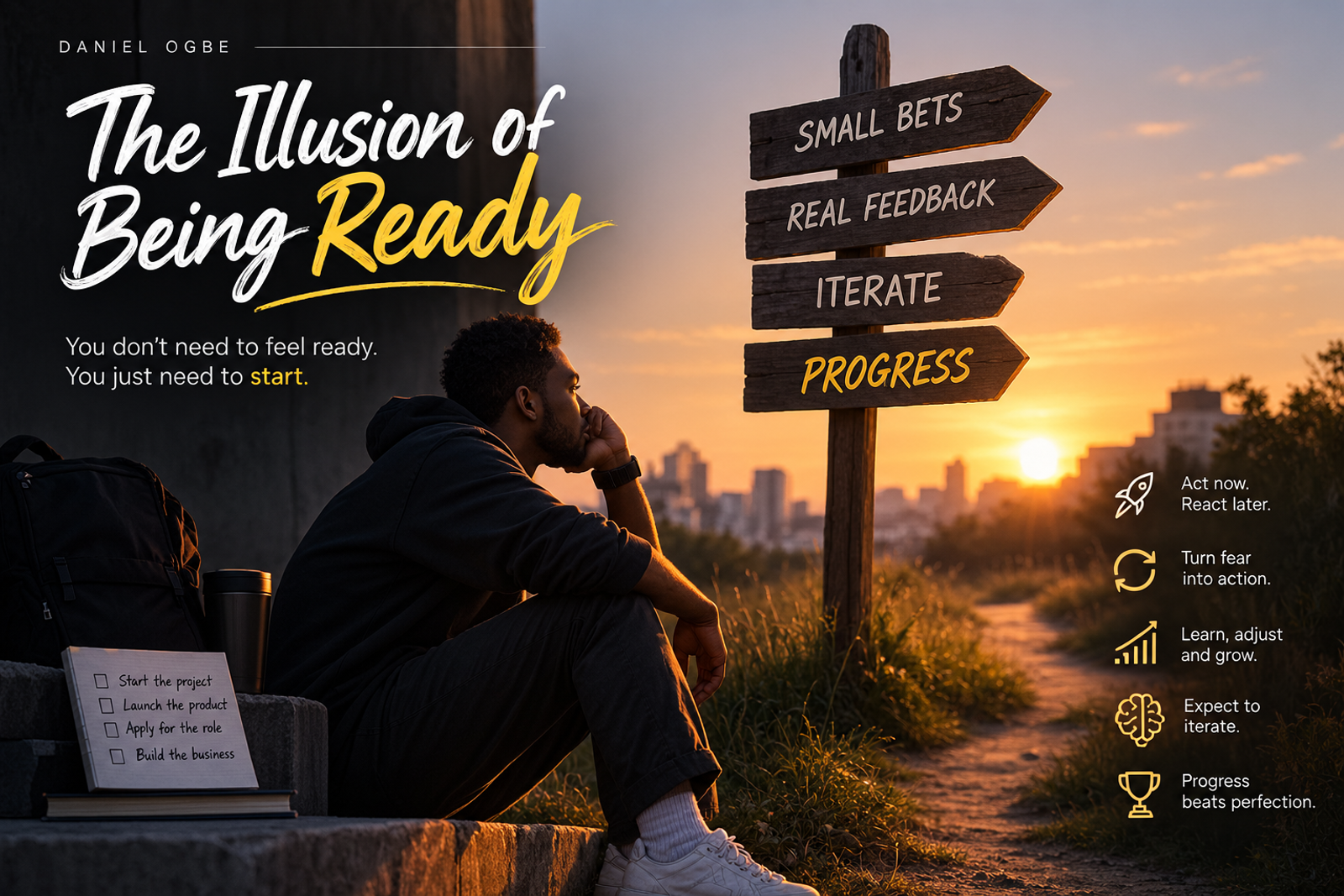
We’ve all felt it before.
That extra beat in your chest when you think about doing the uncomfortable thing you said you would do. The sudden urge to stay comfortable just a little longer. The temptation to push back on a promise you made, especially when that promise was made to yourself and there is no audience to hold you accountable.
And somewhere in the back of your mind is the comforting idea that someday, somehow, the stars will align.
You’ll have more money.
More knowledge.
More confidence.
More time.
More certainty.
And when that moment arrives, you’ll finally be ready.
That moment probably doesn't exist.
No matter how much we intellectually understand this, many of us continue to behave as though readiness is a destination we eventually arrive at before taking meaningful action.
It isn't.
Readiness is often something we construct through action, not something we discover beforehand.
When preparation becomes avoidance
Calculated movement is necessary. There is nothing inherently wrong with planning, researching, strategizing or thinking deeply about a decision.
The problem begins when preparation stops improving the quality of the decision and starts improving our ability to avoid making it.
There is a particular psychological trap here: the more we scrutinize an idea, the more problems we discover.
Another risk appears.
Another scenario we hadn't considered.
Another reason why the timing isn't quite right.
Another loophole.
And because each concern sounds rational in isolation, we convince ourselves that we are being responsible.
But sometimes we aren't preparing.
We're hiding.
Ideas can die in this den of endless planning.
For some people, the underlying fear is failure, the possibility that everything could crumble and they would have to confront the uncomfortable reality that they were the person who made the decision.
For others, it is the fear of being wrong.
If I try and fail, I don't just lose the project. I may have to confront the gap between who I believe I am and what reality says I am capable of doing.
And that can be painful.
So we remain in limbo.
Not failing.
Not succeeding.
Just thinking.
And thinking feels remarkably productive when compared to doing nothing.
The illusion of certainty
Humans are uncomfortable with uncertainty.
We naturally seek information that helps us predict what happens next. The problem is that many meaningful decisions don't provide enough information for certainty to ever arrive.
You cannot research your way into knowing exactly how a business will perform.
You cannot plan your way into knowing whether people will love your product.
You cannot think your way into knowing whether a career move will work.
At some point, the only way to acquire the information you need is to act.
This is where I find the mental model of:
Act now. React later.
particularly useful.
Not act recklessly.
Not ignore obvious risks.
And certainly not stop thinking.
Instead:
Think enough to make the next reasonable bet. Then make it.
Once you've acted, reality gives you something planning alone cannot:
feedback.
The idea might work.
It might fail.
Customers might behave differently from what you expected.
The market might tell you something you couldn't have discovered from your spreadsheet.
Your first version might expose a problem you never anticipated.
Good.
Now you have information.
You can react.
You can adjust.
You can iterate.
You can try again.
This is how most meaningful things are built.
The first version of an idea rarely resembles the final version that people eventually see.
The product changes.
The strategy changes.
The positioning changes.
The person building it changes.
Movement creates information.
And information creates better movement.
From passive fear to active fear
There is another reason action is so powerful.
Before you act, fear is largely hypothetical.
You are afraid of what might happen.
Once you act, the nature of the problem changes.
Now there is something concrete to respond to.
You aren't wondering whether people will use the product anymore.
You have your first ten users.
You aren't wondering whether the job application will work.
You have an interview.
You aren't wondering whether people will pay.
Someone either paid or didn't.
The fear becomes active.
And active problems tend to demand active solutions.
This is an important distinction.
Passive fear keeps you imagining consequences. Active fear forces you to respond to reality.
The latter, while uncomfortable, can be incredibly productive.
Put yourself on the ground where action matters
Sun Tzu's The Art of War contains the concept commonly translated as "death ground", situations in which an army has little or no viable route of retreat.
The psychological intuition is powerful: when retreat disappears, attention becomes concentrated on the problem immediately in front of you.
But there is an important lesson for the modern world.
You don't need to manufacture catastrophe to create urgency.
You can create commitment.
Tell people you're launching.
Publish the first version.
Set a public deadline.
Take on the first customer.
Send the application.
Book the meeting.
Put money behind the project.
Create a situation where doing nothing now has a cost.
These are modern versions of putting yourself on "death ground."
Not because you should destroy your safety net, but because sometimes too many escape routes make inaction incredibly easy.
You probably won't feel ready
Perhaps the biggest mistake is waiting for confidence before taking action.
Confidence is often treated as the prerequisite for action.
In reality, the relationship can work in the opposite direction.
You take the shot.
You survive.
You learn.
You take another shot.
You get better.
Your evidence accumulates.
And eventually, confidence appears.
Not because you convinced yourself that everything would work out, but because you've accumulated enough evidence that you can handle whatever happens next.
That is a much more durable form of confidence.
So the next time you find yourself saying:
"I just need a little more time."
Ask yourself a different question:
"What information will I actually gain by waiting?"
If the answer is meaningful, wait.
If the answer is simply "I'll feel more comfortable," you may have found the illusion.
Because the goal isn't to eliminate resistance before you move.
The goal is to move intelligently despite it.
You don't need perfect certainty.
You don't need perfect timing.
You don't need to feel fearless.
You need enough information to make the next reasonable move.
Then make it.
Act now. React later.